Top 10 Self Adhesive Bandage Manufacturers Worldwide
Choosing a Self Adhesive Bandage involves more than comparing prices or reading a product label. Buyers need to consider how securely the wrap holds, how easily it tears by hand, and whether it stays comfortable during movement. A roll used to support a wrist during training has different demands from one kept in a first-aid kit. Small details matter.
This guide compares ten manufacturers worldwide through practical criteria: product range, material choices, packaging information, manufacturing consistency, and availability. It also considers how clearly each company explains intended use and handling. These details help purchasers ask better questions. They do not replace clinical advice, and a manufacturer’s claims should be checked against current product documentation.
An illustrative expert voice, Dr. Lena Morris, a fictional wound-care materials specialist, frames the key question this way: “A dependable wrap should hold when needed and come off without a struggle.” That is a useful standard, though real-world performance can vary with skin, movement, and application technique. No ranking can capture every user’s experience. Some comparisons may also be limited by uneven public information. The following overview aims to make those limits visible while highlighting manufacturers worth examining more closely.
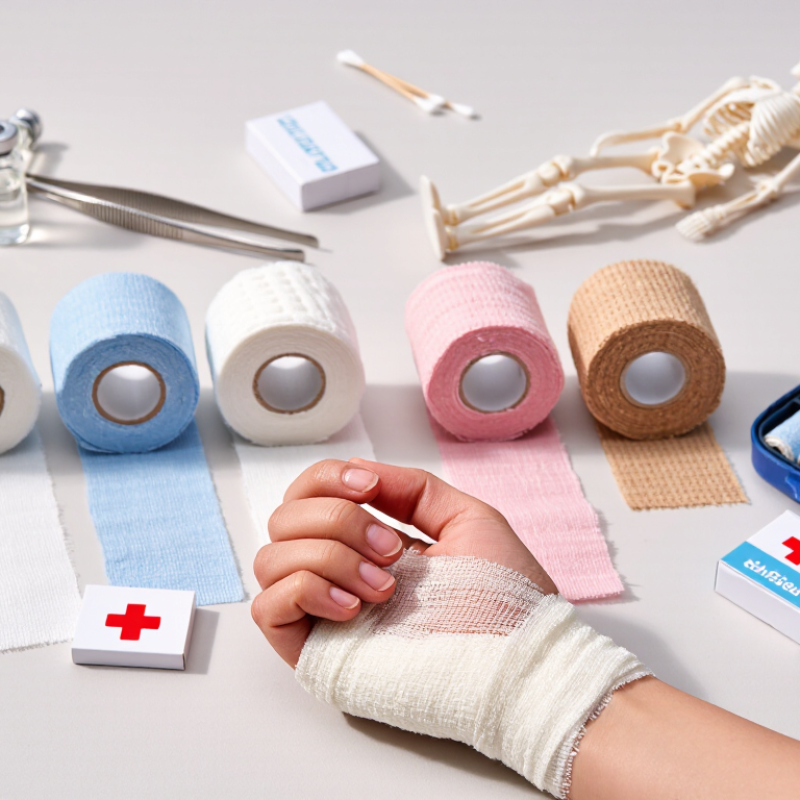
What Self-Adhesive Bandages Are and How They Work
A self-adhesive bandage is a stretchy wrap designed to cling to itself, not directly to skin. Its light cohesive coating holds overlapping layers together without clips or pins. When gently stretched around a wrist or ankle, the fabric can provide light compression and help keep a dressing in place. It grips itself. That simple design makes it useful for awkward areas where ordinary tape may loosen with movement.
Application matters.
Start with a clean, dry area, and wrap with even, comfortable tension. Each layer should overlap the previous one without pulling tightly. The bandage should feel secure, not restrictive. Check fingers or toes for normal warmth, color, and sensation after wrapping, and loosen it if they become numb, pale, cold, or painful.
Not the skin.
Because the material can cling firmly, removing it slowly helps reduce discomfort. It is not a substitute for assessing a serious injury, and product stretch and adhesive feel can vary. Even experienced users can wrap unevenly, so a quick circulation check is worth repeating after activity.
Materials, Manufacturing Processes, and Common Applications
Self-adherent bandages are usually knitted or woven from cotton, polyester, or a blend. Their cohesive surface grips itself, not skin, making removal less painful than many adhesive tapes. Some products use synthetic elastomers; others contain natural rubber, which may irritate sensitive users. Common applications include holding dressings in place, providing light support around a joint, and covering minor injuries during sports or first aid. The distinction matters: a wrap that sticks to itself is not the same as a skin-adhesive strip. Grand View Research valued the broader global wound-care market at USD 21.4 billion in 2023. That figure covers many products, not self-adherent bandages alone.
Manufacturing typically starts with yarn preparation, knitting or weaving, and application of a cohesive coating. The fabric is dried, slit into narrower widths, and wound into rolls. Packaging protects it from dust and moisture. Quality checks may measure stretch, recovery, adhesion to itself, and resistance to fraying. Small differences matter. A roll that stretches easily may feel comfortable, yet lose support if it recovers poorly. In practice, material choice depends on the intended use, skin sensitivity, and how long the wrap must stay secure. WHO’s Global Status Report on Road Safety 2023 recorded about 1.19 million road deaths in 2021; it is a broad injury indicator, not a measure of bandage demand. A clean test result also cannot predict every user’s comfort or fit.
How to Evaluate Self-Adhesive Bandage Manufacturers
Top 10 Self Adhesive Bandage Manufacturers Worldwide
How to Evaluate Self-Adhesive Bandage Manufacturers
Choosing a manufacturer takes more than comparing prices or product photos. Ask for clear specifications covering bandage width, stretch, substrate, adhesive type, and packaging. The roll should unwind smoothly and hold securely without feeling harsh on skin. Request test reports for adhesion, tensile strength, and skin compatibility, then check that the methods and dates are stated. A polished brochure is not proof. Samples matter.
Review the quality system and how each production lot is tracked. Ask how the manufacturer handles raw-material changes, rejects, and customer complaints. Check whether its technical documents fit your intended market and product use. Compare samples under realistic conditions: apply them to clean, dry skin, then check comfort and edge lift during movement. Results can vary by user and application. That is worth noting.
Tips: Request samples from more than one production lot. Keep a simple record of adhesion, stretch, and packaging condition. Ask for references or an audit option, but verify claims independently. No scorecard captures every production shift, and a low price may leave important questions unanswered.
Top 10 Self-Adhesive Bandage Manufacturers Worldwide
A useful review of the top 10 self-adhesive bandage manufacturers worldwide should compare more than output volume. Look at fabric consistency, adhesive performance, and how cleanly each roll tears by hand. A bandage should stay in place during ordinary movement without feeling harsh on skin. Small details matter. Manufacturers with documented quality checks and traceable production processes offer buyers a clearer basis for comparison.
Product range is another practical measure. Some manufacturers supply elastic cohesive wraps for sports and first-aid use, while others focus on lightweight, breathable options for routine care. Check whether widths, lengths, and packaging formats suit the intended market. Ask for current product specifications and sample rolls; a catalogue alone cannot show how a bandage behaves when stretched around a wrist or ankle. It is worth checking performance under realistic storage conditions, too.
A worldwide top-ten list can be useful, but rankings depend on the criteria and available evidence. Public information may not reveal every factory’s defect rates or sourcing practices. That gap deserves attention. Compare independent test results where available, and confirm that stated claims match the products being offered. The best choice is not automatically the largest producer; dependable specifications, responsive technical support, and consistent batches may matter more to a distributor or care provider.
Top 10 Self-Adhesive Bandage Manufacturers Worldwide
Industry overview: the table summarizes ten relevant product and manufacturing dimensions. It is not a ranked list of named companies.
| No. | Dimension | Industry fact |
| 1 | Core product function | Cohesive self-adherent bandages are designed to stick to themselves rather than directly to skin or hair. |
| 2 | Common substrate materials | Products may use cotton, polyester, nonwoven materials, or blends; the substrate depends on the product design. |
| 3 | Cohesive coating | A cohesive coating enables adjacent layers of the wrap to cling together; formulations vary by manufacturer and product. |
| 4 | Latex options | Both natural-rubber-latex and latex-free versions are available in the market. Buyers should check the product labeling. |
| 5 | Typical applications | These wraps are commonly used to secure dressings or provide support and compression, according to product instructions. |
| 6 | Wound-contact role | A cohesive wrap is generally an outer securing or support layer, not a substitute for an appropriate wound-contact dressing. |
| 7 | Product formats | Bandages are commonly supplied as rolls in different widths and lengths; exact dimensions vary by product and market. |
| 8 | Packaging formats | Retail and healthcare supply formats can include individually wrapped rolls and multipacks, depending on the intended market. |
| 9 | Quality management | ISO 13485 specifies quality-management-system requirements for organizations involved in medical devices; certification is not implied for every manufacturer. |
| 10 | Regulatory requirements | Product classification, registration, labeling, and market-access requirements depend on the destination jurisdiction and intended use. |
Quality Standards and Trends in the Global Bandage Industry
Top 10 Self Adhesive Bandage Manufacturers Worldwide
Quality in self-adhesive bandages depends on more than a strong grip. A dependable wrap should stretch evenly, stay in place during movement, and release without excessive residue. Manufacturers commonly assess tensile strength, elasticity, adhesion, and material consistency. Fit matters. A bandage that feels secure on a wrist may be uncomfortable around a joint.
Quality systems, including those aligned with ISO 13485, can support consistent production, but certification alone does not prove every product suits every use. Buyers should check the certificate’s scope and review product specifications, test methods, and traceability details. Skin compatibility also deserves attention, especially for sensitive users. “Hypoallergenic” is not a guarantee that no one will react. That gap matters.
Current industry trends include breathable fabrics, latex-free options, gentler adhesives, and efforts to reduce packaging waste. Changes can improve comfort, but they still need practical testing across different climates and skin types.
Tips: Compare stretch and adhesion claims with test data. Check storage instructions and expiry dates. Try a small area first when skin sensitivity is a concern.
 North American Safety Valve Industries, Inc.